
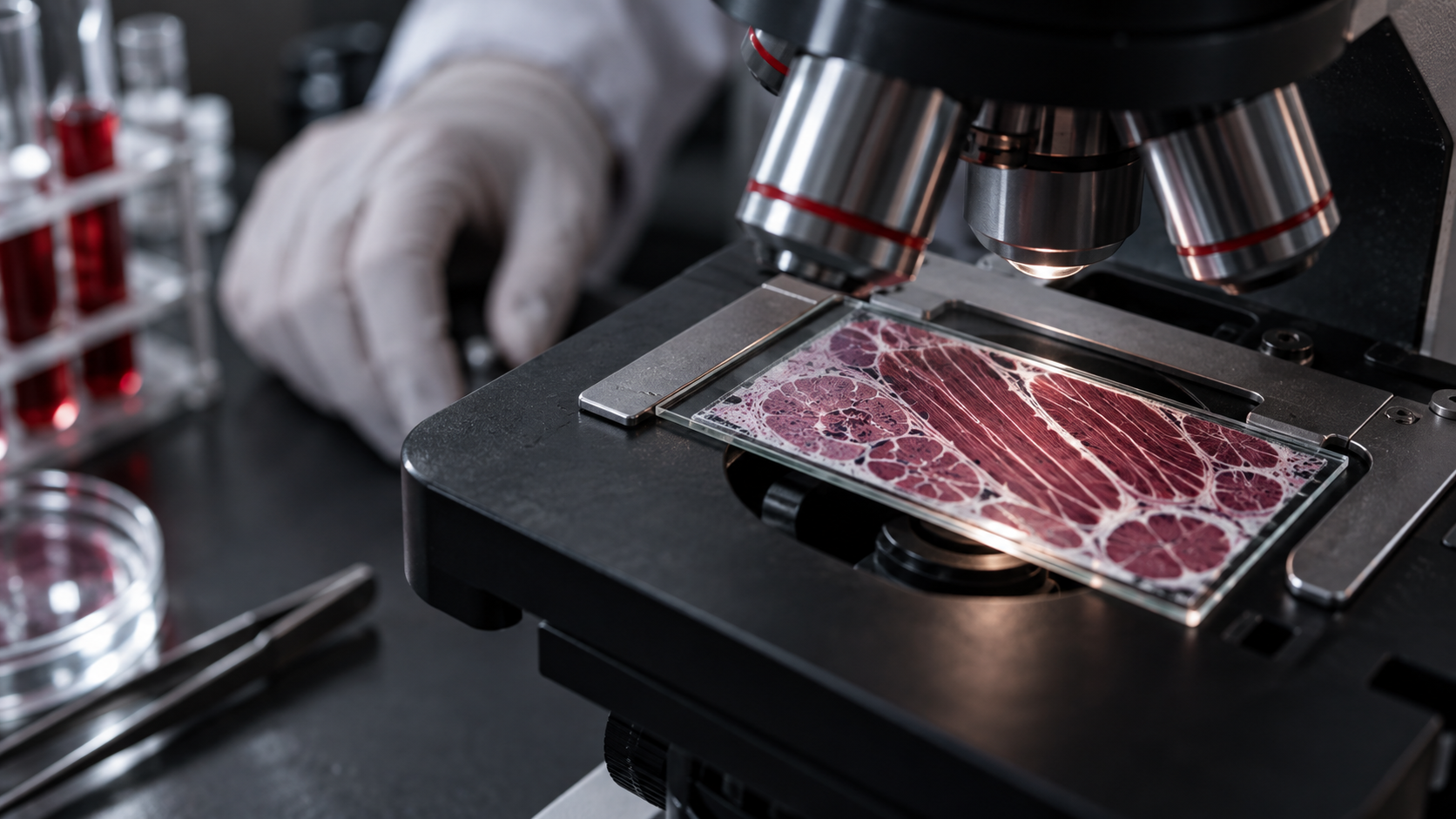
Educational discussion of published research. Viking Stack products are for laboratory research only—not for human or veterinary use.
Muscle biology involves growth signals, inhibitory pathways, energy metabolism, and tissue repair. Follistatin-344, tesamorelin, CJC-1295, and TB-500 draw research interest because they connect to different parts of that picture. Understanding each pathway separately is necessary before testing whether any interaction is meaningful.
Follistatin-344 and growth inhibition
Follistatin binds myostatin, a protein involved in limiting muscle growth, and interacts with related signals such as activins. Researchers study whether changing those signals affects tissue size and function.
FS344 is a precursor form investigated in gene-therapy research. In a small early study involving six people with Becker muscular dystrophy, investigators delivered an FS344 gene to thigh muscles; four participants improved six-minute walking distance, and biopsies showed encouraging changes. That gene-therapy intervention is not equivalent to a laboratory vial of follistatin. Larger, controlled studies are needed to interpret functional benefit and risk.
Tesamorelin and body composition
Tesamorelin is a growth hormone-releasing hormone analog that stimulates GH release and influences IGF-1. Its strongest clinical evidence concerns visceral-fat reduction in adults with HIV-associated abdominal fat accumulation. A randomized trial reported an approximately 18% reduction in visceral fat. A separate analysis linked meaningful visceral-fat reduction with changes in muscle area and density. Those findings justify studying muscle quality alongside quantity; they do not establish a general muscle-building indication.
Tesamorelin has also been investigated in a controlled cognitive study involving older adults. This illustrates the breadth of questions surrounding the pathway, not a claim about unrelated research products.
CJC-1295 and signaling duration
CJC-1295 is another synthetic GHRH analog. The long-acting form studied in human trials uses a drug affinity complex (DAC). In two randomized, placebo-controlled trials, investigators observed sustained increases in GH and IGF-1 concentrations after a single administration. Hormone-marker changes do not by themselves establish changes in muscle mass, strength, recovery, or safety. Those outcomes require direct measurement.
TB-500 and repair models
TB-500 is associated with a synthetic fragment of thymosin beta-4. Exact compound identity matters: findings for full-length thymosin beta-4 cannot simply be assigned to a fragment sold under a different name.
Animal wound studies of full-length thymosin beta-4 reported changes in cell migration, blood-vessel formation, and collagen deposition. A separate mouse study investigated a synthetic peptide containing an actin-binding region. These are starting points for model-based investigation, not evidence of a human musculoskeletal outcome for TB-500.
Combination research remains a hypothesis
The proposed pathway map is interesting: follistatin relates to growth inhibition; tesamorelin and CJC-1295 both engage GH signaling; thymosin-related studies examine repair. Shared pathway activity also raises the possibility of overlap rather than added benefit.
Any claim of synergy would need controlled comparisons, confirmed compound identity, functional outcomes, and safety assessment. Nutrition, activity, and recovery conditions would also need to be accounted for. No combination benefit is established by grouping compounds in a research stack.
Sources & further reading
This article is educational and does not establish safety, efficacy, or suitability of any Viking Stack product for human or veterinary use. Product descriptions are not medical advice.
← BACK TO ALL ARTICLES